Mandy Rogers
The Black-Eyed BlondeMandy Rogers is an aspiring actress working at the edges of the film industry, where Nico Peterson had helped her find work and was trying to advance her career. Her brief interview with Philip Marlowe supplies a practical lead in his search for Nico, but it also establishes the limits of what she can tell him: she knew Nico as a would-be agent and professional contact, not as a confidante with a clear account of his private life.
Identity and Work
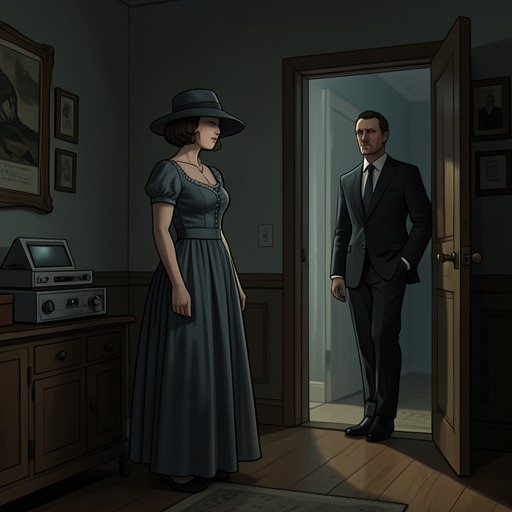
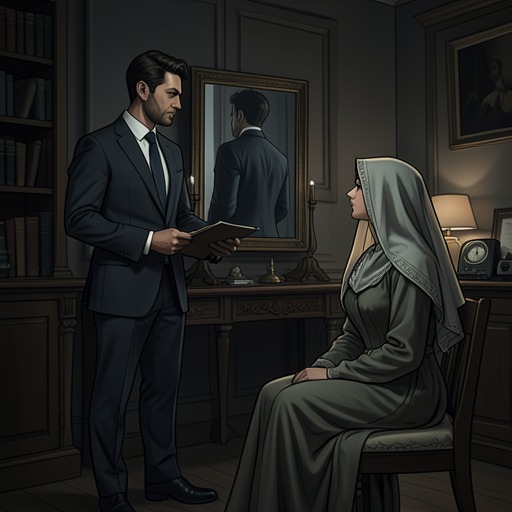
Mandy is introduced at Excelsior Studios, where studio security officer Hal Wiseman brings Marlowe to meet her in the commissary. At their first encounter, she is seated by a window, posing with a hand at her chin and gazing outward. The description makes her occupation legible before the conversation begins: she is accustomed to presenting herself for an audience, even in an ordinary setting. Marlowe reads her pose as a performance, though his impression belongs to his own observant and often flirtatious point of view rather than to an objective account of her character.
Her appearance and manner are presented through that same filtered perspective. Marlowe notices her blond hair and large, expressive eyes, and thinks that the polish associated with film people reaches even those with modest careers. When she greets him, her voice does not match the effect he had expected from her cinematic presentation. The contrast punctures his initial fascination, while showing how quickly he converts a new acquaintance into an image shaped by the movies and his own assumptions.
Nico Peterson and Her Career
Mandy’s strongest documented connection to Nico is professional. When Marlowe asks whether Nico was her agent, she qualifies the description: Nico wanted to act as her agent and did get her some work. One example was her appearance in Riders of the Red Dawn. The distinction matters. Nico had helped her, but the evidence does not establish that he held a formal or consistently successful position in her career.
She last saw him about a week before his reported death. At that time, Nico was working to get her a part in a new Doris Day film, a prospect she discusses alongside the possibility that Rock Hudson might also appear. Her recollection ties Nico’s last known contact with her to a concrete professional effort, rather than to a personal farewell or an explanation of his circumstances. She then considers the part lost because of his death. The exchange makes the news register as a setback to her immediate hopes, without establishing that she did not care about him or that she knew more about his disappearance.
Marlowe also asks about Nico’s friends and whether he had a girlfriend. Mandy says that he had plenty of girlfriends, but the exchange does not establish that she knew any of them or could identify someone who might know where he had gone. Her answer gives Marlowe a broad impression of Nico’s social life, not a verifiable trail. The difference between what she has heard and what she can personally confirm keeps her interview useful but limited.
Interview and Performance
In conversation, Mandy tries on different social presentations. Marlowe perceives shifts between a youthful, eager manner and a more alluring one, and concludes that she has tested several parts in the few minutes since he arrived. This observation connects her behavior to the work she hopes to obtain: she is not simply described as an actress but as someone negotiating how to be seen. Yet Marlowe’s reading remains an outsider’s judgment, colored by his tendency to interpret women through appearance and performance. The scene gives no independent account of what Mandy intends by each change of manner.
Her account of Nico is correspondingly practical. She can name the work he helped secure and the role he was pursuing for her, but she does not provide a hidden explanation for his reported death. Her attention returns to whether the new opportunity will still be available. That concern gives the interview a small, human scale: a missing man’s professional promise has abruptly become uncertain, and Mandy is left assessing what his absence means for her prospects.
Narrative Role and Limits
Mandy functions as one of Marlowe’s leads because Clare Cavendish had mentioned that Nico worked with an actress. Marlowe recalls the name while considering whom to approach next, contacts Hal Wiseman, and is introduced to Mandy at the studio. The sequence shows how his investigation advances through ordinary professional connections rather than through a complete account delivered by a single witness. Mandy confirms that Nico had been trying to help her, but her evidence does not resolve where he went or whether he was alive.
The scene also places the glamour of Hollywood beside its uncertainty. Mandy presents herself with the composure of someone practiced in being watched, yet her career remains dependent on precarious opportunities and other people’s assistance. Nico’s promised introduction to a film role is suddenly in doubt; Marlowe’s inquiry, meanwhile, treats that same professional relationship as a clue. Mandy’s significance is therefore both personal and structural: she gives the investigation a specific route into Nico’s recent activities, while revealing how little that route can establish about his private fate.